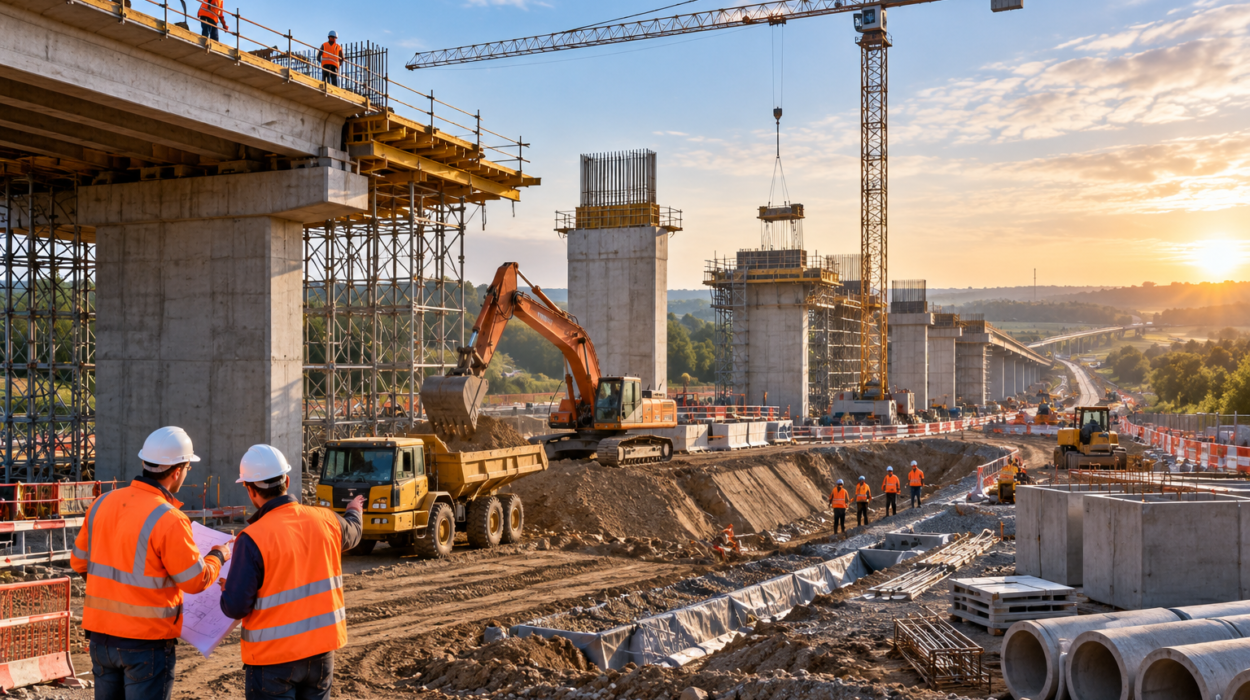
Infrastructure construction projects often involve significant investment, complex engineering requirements, and demanding delivery schedules. Before appointing a contractor, clients want evidence that the company has successfully completed similar work.
A list of services rarely provides enough information to establish that confidence.
Project case studies offer a more convincing way to demonstrate experience. They explain what a contractor delivered, which challenges were encountered, and how the project was managed.
For companies involved in roads, bridges, utilities, drainage, and major civil engineering developments, detailed case studies can become valuable marketing and business development assets.
They can support tender submissions, strengthen professional introductions, and help prospective clients understand your technical capabilities.
However, effective case studies require more than attractive photographs and general statements about successful delivery.
This guide explains how infrastructure construction companies can create credible project case studies that demonstrate expertise and support future business opportunities.
Why Project Case Studies Matter in Infrastructure Construction
Infrastructure clients often evaluate contractors against detailed technical and commercial requirements.
Previous project experience may form part of that assessment.
A well-prepared case study provides context that a basic project list cannot offer.
It can explain the construction environment, project requirements, technical challenges, and your company’s responsibilities.
Case studies also help potential clients identify similarities between completed work and their proposed developments.
However, they should support rather than replace formal project references and procurement documentation.
Choose Projects That Reflect Your Core Services
Not every completed project deserves an extensive case study.
Prioritise developments that demonstrate the services you want to promote.
For example, a highway contractor might showcase a complex road improvement scheme.
A drainage specialist could feature a major surface water management project.
A bridge construction company might highlight structural works involving difficult site conditions.
Select projects based on relevance.
Consider technical complexity.
Review contract values where appropriate.
Identify unusual challenges.
Avoid choosing projects solely because they look impressive in photographs.
Match Case Studies to Your Target Clients
Different infrastructure clients have different priorities.
A local authority may want evidence of successful public highway works.
A utility provider may be interested in experience working around operational networks.
A private developer may need a contractor capable of delivering access roads and associated infrastructure.
Identify your intended audience.
Understand their likely requirements.
Choose relevant examples.
Highlight appropriate capabilities.
Avoid presenting unrelated projects as direct evidence of specialist expertise.
Targeted case studies make your experience easier to evaluate.
Explain the Project Background
Every strong case study needs context.
Start by explaining what the development involved and why the work was required.
Describe the infrastructure type.
Identify the general location.
Explain the project objectives.
Provide appropriate information about the client.
Mention relevant site conditions.
Avoid lengthy background sections that distract from your company’s contribution.
The introduction should help readers understand the project quickly.
Clearly Define Your Company’s Responsibilities
Infrastructure developments often involve multiple contractors and consultants.
Your case study should distinguish between the overall project and the work your company actually performed.
Explain whether you acted as principal contractor, specialist subcontractor, or another delivery partner.
Identify the construction activities you completed.
Describe relevant coordination responsibilities.
Clarify the scope of your involvement.
Avoid implying that your company delivered an entire development when it completed only one package.
Accuracy strengthens credibility.
Describe the Technical Challenges
Technical challenges often provide the most valuable information in an infrastructure case study.
These might involve restricted access, difficult ground conditions, existing utilities, complex structural requirements, or demanding construction sequences.
Identify the relevant problem.
Explain why it mattered.
Describe the constraints.
Discuss the practical implications.
Avoid exaggerating routine activities into major engineering achievements.
Specific challenges help demonstrate genuine experience.
Explain How Your Team Approached the Work
Once the challenge is established, explain your company’s response.
Describe relevant construction methods.
Discuss planning considerations.
Explain coordination arrangements.
Identify suitable equipment.
Highlight appropriate technical decisions.
Avoid disclosing confidential engineering information.
The objective is to demonstrate professional problem-solving rather than reveal every construction detail.
Include Relevant Project Specifications
Technical information can help infrastructure clients assess the scale and complexity of completed work.
Depending on the project, useful details may include:
- Type of infrastructure constructed.
- Length or dimensions of relevant works.
- Principal construction materials.
- Ground or site conditions.
- Specialist equipment requirements.
- Construction programme.
- Your company’s contractual role.
Use verified figures.
Explain technical terminology where necessary.
Avoid including measurements that cannot be confirmed.
Demonstrate Effective Project Management
Infrastructure clients need confidence in a contractor’s management capabilities.
Your case study should explain relevant delivery arrangements.
Describe planning procedures.
Discuss subcontractor coordination.
Explain communication with project stakeholders.
Highlight appropriate quality controls.
Address relevant programme considerations.
Avoid making unsupported claims about flawless delivery.
Practical examples are more persuasive than generic statements.
Show How Safety Was Managed
Infrastructure construction can involve substantial operational risks.
Relevant examples may include excavations, lifting operations, traffic management, or work near existing services.
Explain the safety considerations associated with the project.
Describe appropriate management procedures.
Highlight relevant training or supervision.
Discuss suitable controls.
Avoid publishing sensitive information or unsupported safety claims.
Accurate descriptions help demonstrate responsible construction practices.
Highlight Environmental Considerations
Infrastructure developments may involve environmental constraints.
These can include water management, protected habitats, noise, dust, and waste handling.
Explain relevant requirements.
Describe appropriate procedures.
Highlight practical solutions.
Provide verified outcomes where available.
Avoid exaggerated sustainability statements.
Credible environmental information can strengthen the case study.
Use Genuine Construction Photographs
Photographs help readers understand the work completed.
Include images from relevant construction stages where possible.
Show the original site conditions.
Document important activities.
Highlight technical details.
Include completed works.
Obtain necessary permissions.
Avoid using unrelated stock photographs as evidence of your company’s experience.
Genuine imagery makes the project easier to understand.
Create Before-and-After Comparisons
Before-and-after photographs can be particularly effective for visible infrastructure improvements.
Examples might include road reconstruction, drainage upgrades, or bridge refurbishment.
Choose comparable viewpoints.
Explain the work undertaken.
Identify relevant improvements.
Provide accurate descriptions.
Avoid manipulating photographs to exaggerate results.
Clear comparisons help communicate project outcomes.
Include Verified Project Results
Results are often the strongest part of a case study.
Explain what was delivered.
Highlight completed infrastructure assets.
Discuss verified programme outcomes.
Describe relevant technical achievements.
Include measurable results where available.
Avoid inventing performance statistics.
A credible outcome is more valuable than an impressive but unsupported claim.
Explain Unexpected Problems Responsibly
Infrastructure projects don’t always proceed exactly as planned.
Ground conditions, weather, existing utilities, or design changes can create additional challenges.
Where appropriate, explain how your company responded.
Describe the issue.
Identify relevant constraints.
Discuss corrective measures.
Highlight lessons learned.
Avoid disclosing confidential disputes or commercially sensitive information.
Professional problem-solving can demonstrate experience.
Obtain Permission Before Publishing
Infrastructure projects may involve confidentiality obligations.
Clients, principal contractors, or project owners may restrict the use of photographs and project information.
Review contractual requirements.
Seek appropriate permissions.
Confirm whether client names can be published.
Check photographic restrictions.
Remove sensitive information.
Avoid assuming that publicly visible construction work can be described without limitation.
Responsible publication protects professional relationships.
Add Client Testimonials Where Appropriate
A genuine testimonial can complement technical project evidence.
Request permission before publication.
Use accurate quotations.
Provide suitable context.
Identify the client where authorised.
Avoid editing feedback in a misleading way.
Testimonials can strengthen credibility, but they should not replace factual project information.
Structure Case Studies for Easy Reading
Infrastructure professionals may review several contractor websites during preliminary research.
Make your content easy to navigate.
Use descriptive headings.
Keep paragraphs concise.
Include relevant photographs.
Present technical information clearly.
Highlight important outcomes.
Avoid excessive promotional language.
A logical structure helps readers locate useful information quickly.
Optimise Case Studies for Search Engines
Project case studies can support organic visibility when they contain useful, relevant information.
A well-planned SEO for infrastructure construction strategy can connect case studies with appropriate service pages and related technical resources.
Use descriptive page titles.
Include relevant infrastructure terminology naturally.
Optimise image descriptions.
Add appropriate internal links.
Maintain good page performance.
Avoid excessive keyword repetition.
Search optimisation should improve accessibility without reducing content quality.
Connect Case Studies to Relevant Service Pages
Case studies shouldn’t exist in isolation.
Link them to the services they demonstrate.
A bridge refurbishment case study might connect to a structural repair service page.
A drainage project could link to relevant civil engineering services.
Use descriptive anchor text.
Maintain logical navigation.
Avoid excessive linking.
Clear connections help visitors explore your capabilities.
Use Case Studies in Tender Submissions
Relevant project examples can support procurement responses.
However, tender documents may specify particular formats and evidence requirements.
Select appropriate case studies.
Adapt information to the evaluation criteria.
Verify project details.
Provide suitable references.
Follow submission instructions.
Avoid assuming that a website case study automatically satisfies formal procurement requirements.
Tailored evidence is essential.
Share Case Studies on LinkedIn
LinkedIn can help infrastructure contractors reach developers, engineers, and project managers.
Share completed project summaries.
Highlight technical challenges.
Include authorised photographs.
Explain relevant outcomes.
Link to the full case study.
Avoid repetitive promotional messages.
Professional updates can increase awareness of your experience.
Turn Case Studies Into Other Marketing Materials
One completed project can support several business development activities.
A detailed case study may provide material for a capability statement, company brochure, professional presentation, or industry article.
Adapt the information for each audience.
Maintain factual consistency.
Use appropriate photographs.
Respect publication permissions.
Avoid repeating identical promotional messages across every channel.
Reusing verified project information can improve marketing efficiency.
Keep Your Project Portfolio Updated
An outdated portfolio may fail to reflect your current capabilities.
Review completed projects regularly.
Add relevant new case studies.
Update company information.
Remove inaccurate details.
Check image permissions.
Maintain working links.
Avoid presenting old projects as recent achievements.
A current portfolio supports more accurate contractor evaluations.
Measure Case Study Performance
Case studies should contribute to meaningful business development outcomes.
Monitor relevant website visits.
Track enquiries associated with project pages.
Review how case studies support tender submissions.
Record client feedback.
Identify frequently requested project examples.
Avoid measuring success only through page views.
The objective is to demonstrate expertise and support suitable opportunities.
Common Infrastructure Case Study Mistakes
Several mistakes can reduce credibility.
These include:
- Publishing generic project descriptions.
- Failing to explain technical challenges.
- Exaggerating company responsibilities.
- Using unrelated stock photographs.
- Including unverified statistics.
- Ignoring confidentiality requirements.
- Neglecting project outcomes.
- Using excessive technical jargon.
- Publishing outdated information.
- Failing to connect projects with relevant services.
Avoid treating case studies as simple photo galleries.
Their value comes from explaining genuine construction experience.
Create a Repeatable Case Study Process
Develop a consistent approach for documenting completed projects.
Identify suitable developments.
Collect verified project information.
Record your company’s responsibilities.
Document relevant challenges.
Gather authorised photographs.
Confirm measurable outcomes.
Obtain publication permissions.
Prepare a structured case study.
Publish it on your website.
Share it through appropriate professional channels.
Review the content periodically.
A repeatable process helps maintain a useful portfolio as your company completes more work.
Final Thoughts
Project case studies provide infrastructure construction companies with a practical way to demonstrate technical expertise, management capabilities, and relevant project experience.
They help prospective clients understand what your company has delivered and how it approaches demanding construction challenges.
Strong case studies combine accurate project information, genuine photographs, clearly defined responsibilities, and verified outcomes.
They can also support tender submissions, professional networking, search visibility, and wider marketing activities.
However, credibility depends on accuracy.
By documenting completed projects carefully and presenting the information clearly, infrastructure contractors can build a stronger professional portfolio and improve their ability to attract suitable future opportunities.
